



Pipe Truss
What is Pipe Truss
TRUSS PIPE is a thermoplastic composite, double-wall pipe with concentric inner and outer walls braced by a truss-type structure. The truss voids are filled with lightweight Mearlcrete for additional stiffness and compressive strength.
Benefits of Pipe Truss
Strong stability
The pipe truss is made of relatively solid materials, which can withstand large external forces and has strong wind and earthquake resistance to ensure the stability of the building.
Lightweight structure
The material of the pipe truss is relatively light, which can reduce the weight of the building and reduce the pressure on the foundation, making it more suitable for long-span buildings.
High reliability
The pipe truss connecting parts are fastened with high-strength bolts, which have good reliability and corrosion resistance.
High construction efficiency
Pipe truss members are lightweight, easy to transport and install, and can complete construction tasks quickly and efficiently.
Beautiful appearance
The tube truss structure is simple and elegant. Through the illumination of light, it can produce a unique three-dimensional effect, making the building more beautiful.


Why Choose Us
Rich experience
Dedicated to strict quality control and attentive customer service, our experienced staff is always available to discuss your requirements and ensure complete customer satisfaction.
Customer Service
We firmly believe that we offer THE BEST customer support in the industry and it is our ongoing goal to continually improve on our services. As an independently owned and operated business, we are able to provide the most accommodating service possible.
Professional team
Our professional team collaborate and communicate effectively with one another, and are committed to delivering high-quality results. They are capable of handling complex challenges and projects that require their specialized expertise and experience.
One-stop solution
At our manufacturing facilities, we provide a complete package that includes everything required to get you started, including training, installation and support.
High quality products
We always put customer needs and expectations in the first place, refine on, continuous improvement, to seek every opportunity to do better, to provide customers with their expectations of quality products, to provide customers with the most satisfactory service at anytime.
Quality Control
All goods will undergo strict quality inspection before shipment. MCC always insists on providing high-quality products. We firmly believe that quality is the basis of everything.
Classification of Steel Tube Trusses


Fixed tube truss
The most vital type is one with high reusability. The only disadvantage is the high transportation cost. It is divided into two types: square tube and round tube.
Folding tube truss
The most significant advantages are low transportation costs and poor reusability. It is divided into two types: square tube and round tube.
Butterfly tube truss
The most artistic type of truss, with a unique and beautiful shape.
Ball joint tube truss
Also called a ball joint frame, this type of truss has a beautiful and sturdy shape. It is also the most expensive type of truss.
Triangular tube truss
Under the node load evenly distributed along the span, the axial force of the upper and lower chord members is most significant at the endpoints and gradually decreases toward the middle of the span; the axial force of the web members is the opposite.
Triangular trusses are primarily used in roof trusses with tile roofs due to the significant difference in the internal forces of the chords and unreasonable material consumption.
Trapezoidal tube truss
The stress of the rods has been improved compared with triangular trusses, and when used in roof trusses, they can more easily meet the process requirements of some industrial plants.
If the upper and lower chords of the trapezoidal truss are parallel, it is a parallel chord truss. The stress of the rods is slightly worse than that of the trapezoidal truss, but the types of web rods are significantly reduced, and they are primarily used in bridges and trestles.
Polygonal tube truss
It is also called a polygonal truss. The upper chord node is located on the quadratic parabola. If the upper chord is arched, the bending moment generated by the internodal load can be reduced, but the manufacturing is more complicated.
Under the action of uniform load, the shape of the truss is similar to the bending moment pattern of a supported beam, so the upper and lower chord axial forces are evenly distributed, the web rod axial force is small, and the material consumption is the least. It is a commonly used truss form in engineering.
Open-web tube truss
This type of truss adopts the shape of a polygonal truss, with straight lines between the upper chord nodes, no oblique web bars, and only vertical web bars connected to the upper and lower chords.
The axial force distribution of toolbox members is similar to that of polygonal trusses, but the bending moment value of the member end changes significantly under asymmetric load. The advantage is that there are fewer rods intersecting at the nodes, and construction and manufacturing are convenient.
Sports facilities
Due to basic requirements such as large spans and high clearance, sports venues are completely constructed using membrane structures, with fast construction speed, low cost, and good self-cleaning properties.
Transportation facilities
It is usually used as a parking lot, toll station, gas station terminal, train station, airport, etc. It mainly plays the role of sheltering from wind and rain. Convenient transportation is the main reason for high cost performance.
Commercial facilities
Membrane structure is a building that perfectly embodies rigidity and softness, strength and beauty. It has high flexibility, unique and fashionable decoration, and has become the first choice for commercial streets such as canteens, shopping malls, and hotels.
Industrial facilities
The membrane structure is easy to dismantle, has the advantages of low construction cost and high space utilization. Thus becoming the most popular building in modern architecture.
Landscape facilities
The membrane structure can perfectly integrate with the natural environment and complement each other to form a beautiful landscape.
What Is the Difference Between Grid Trusses and Tube Trusses
The grid structure is an indoor space structure composed of multiple rods connected to each other according to nodes according to a certain grid diagram. It has the advantages of indoor space support, light weight, high bending stiffness, and good seismic performance; it can be used as a sports venue, cinema, exhibition hall, waiting hall, sports venue infield canopy, aircraft hangar, double column grid structure and production workshop Roof trusses for engineering buildings. The disadvantage is that the number of rods intersecting at the nodes is large, and the production and installation are more complicated than the plan structure.
A truss structure is a planar or spatial structure composed of straight rods and generally has triangular modules. Under load, the truss members mainly bear radial tensile force or pressure, thereby making full use of the strength of the material. When the span is large, it saves material compared to solid web beams, reduces weight and increases bending stiffness. , so it is suitable for large-span load-bearing structures and towering structures, such as steel roof trusses, highway bridges, power line towers, communication satellite transmission towers, water conservancy gates, lifting equipment racks, etc.
Compared with the grid structure, the tube truss structure omits the lower vertical members and the ball joints of the spherical grid, and can meet the requirements of various different building forms, especially the construction of round arches and random curves than the grid structure. The structure has more advantages. It has the same reliability in all directions and saves the use of raw materials. Seamless steel tube truss structure is developed on the basis of grid structure.
Compared with the grid structure, it has unique advantages and applicability, and the steel content of the structure is also more economical.
Compared with traditional open-section (H-shaped steel and I-shaped steel) steel pipe trusses, the pipe truss cross-section materials are more evenly distributed around the central axis, so that the cross-section has excellent compressive strength and bending strength and torsional capacity at the same time. It has high bending stiffness, no need for gusset plates, and a simple structure. The most important thing is that the tube truss structure has a beautiful appearance, which is conducive to the shape design and a certain decorative effect. pipe truss The overall performance of the frame structure is good, with high torsional bending stiffness and beautiful appearance. It is relatively easy to manufacture, install, turn over and hoist. The seamless steel tube roof truss made of cold-drawn thick-walled channel steel has a light structure and high bending stiffness. It is good, saves stainless steel, and can take full advantage of the strength of the material. It is especially more economical to choose the pressure rod and support system controlled by the slenderness.
Basics of design
The design of the tube truss structure should comply with the national building design specifications, steel structure design specifications and relevant industry standards, while taking into account factors such as the structure's use environment, load characteristics, material performance and manufacturing technology. Adequate survey and investigation should be conducted before design, including site geology, climatic conditions, surrounding environment, transportation, etc., to determine the foundation and support method of the structure, while taking into account the feasibility and economy of construction.
Load calculation
The load calculation of the tube truss structure should follow the national building load specifications and steel structure design specifications, taking into account factors such as static load, dynamic load, temperature load, wind load, and earthquake load. The overall stability, local stability and fatigue life of the structure should be considered during the calculation process to ensure the safety and reliability of the structure. At the same time, appropriate analysis methods and calculation software should be selected according to specific circumstances to carry out refined calculations and simulations.
Material selection
The materials of the pipe truss structure should comply with national standards and relevant industry standards, while taking into account the use environment and load characteristics of the structure. The selection of pipes should consider factors such as strength, stiffness, toughness and corrosion resistance, as well as the feasibility of processing and connection. The selection of connectors should consider factors such as strength, stiffness, fatigue life and reliability, as well as the convenience of manufacturing and installation. Adequate testing and inspection should be carried out during the material selection process to ensure the performance and quality of the material.
Fabrication and installation
The manufacture and installation of pipe truss structures should comply with national standards and relevant industry standards, taking into account the design and load characteristics of the structure. Adequate processing and inspection should be carried out during the manufacturing process to ensure the size and quality of pipes and connections. During the installation process, the overall stability and local stability of the structure should be considered, while attention should be paid to construction safety and quality control. Adequate supervision and inspection should be carried out during the manufacturing and installation processes to ensure the safety and reliability of the structure.
Maintenance and inspection
Maintenance and inspection of pipe truss structures should be carried out regularly to ensure the safety and reliability of the structure. Adequate cleaning and maintenance should be carried out during maintenance to extend the service life of the structure. During the inspection process, attention should be paid to the overall stability and local stability of the structure, and the fatigue life and damage degree of the structure should also be considered. Adequate records and reports should be made during maintenance and inspection to facilitate the management and maintenance of the structure.
The connection structure of steel tube truss nodes includes node plates, vertical web members, diagonal web members and chord members. The connection structure of steel pipe truss nodes is characterized in that: the node plate is a rectangular connecting steel plate with a dovetail angle, and is provided with an ear plate, and the node plate and the ear plate are cross-fixed together. The ends of the vertical web bars, oblique web bars and chord bars are all provided with cutting grooves; insert the gusset plate into the cutting grooves, and weld the vertical web bars, oblique web bars, chord bars and gusset plates into a node-connected whole. Compared with the existing technology, the steel tube truss node connection structure has a simple structure, a large node connection load-bearing capacity, a smoother and smoother force transmission, and reduces the stress concentration of the nodes. After the structural safety is improved, the steel tube truss node connection structure is particularly suitable for structural bearing In the case of dynamic load, the manufacturing cost is low, the installation is convenient, and the construction period is short.
The comprehensive review of product specifications, technology, product type, and production analysis provided by the Steel Truss Market Business Report takes into account important variables like revenue, cost, and gross margin. This excellent market study was created using data and information gathered from reliable sources, including corporate websites, white papers, journals, mergers, etc. Basic, secondary, and advanced data on the state of the world economy, current trends, market size, sales volume, market share, growth, analysis of potential future trends, and market segmentation are all included in the Steel Truss Market study.

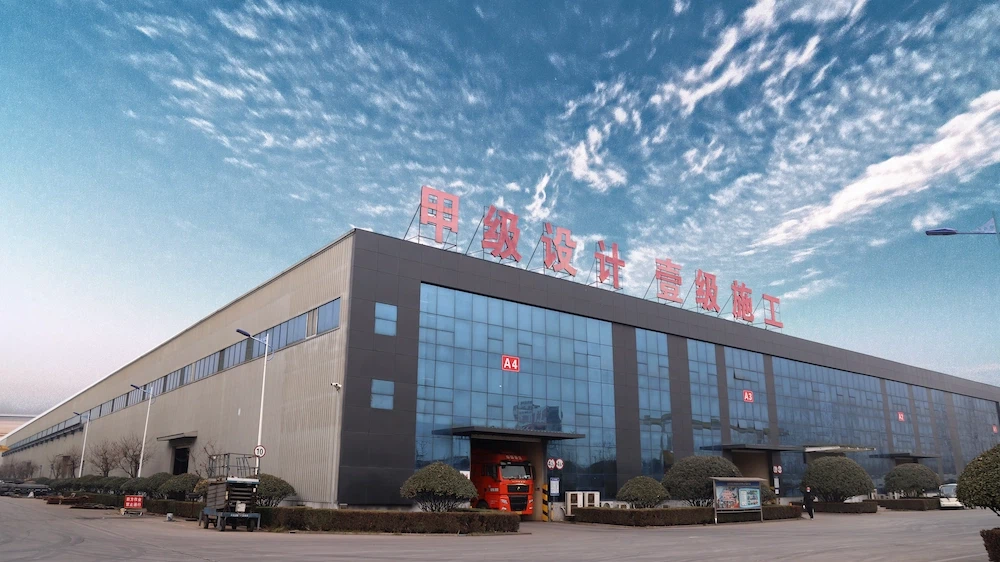
Our Factory
The company was founded in March 2013, the registered capital of 100 million yuan. The company has the national steel structure manufacturing special grade, metal roof (wall) surface design and construction special grade, steel structure, curtain wall design grade A, steel structure, curtain wall professional contracting grade 1 and other 17 qualifications; Shandong Province prefabricated building industry base. Can provide one-stop service from design, processing and manufacturing, construction and installation, engineering consulting management.


Certifications
The company has the national steel structure manufacturing special grade, metal roof (wall) surface design and construction special grade, steel structure, curtain wall design grade A, steel structure, curtain wall professional contracting grade 1 and other 17 qualifications
It is a member of China Steel Structure Association, a member of China Building Metal Structure Association, a vice president of Shandong Steel Structure Industry Association, and a governing unit of Shandong Civil Construction Society Assembly Building Committee. It has passed ISO9001, ISO1400, OHSAS18001 system certification, and has dozens of national patents.


FAQ
As one of the leading pipe truss manufacturers and suppliers in China, we warmly welcome you to buy pipe truss made in China here from our factory. All our products are with high quality and competitive price. Contact us for pricelist and quotation.
transportation aluminum magnesium manganese plate, display stand pipe truss, steel bridge components